Ever wonder why videogames are so addictive? Or why you spend hours scrolling on Tiktok?
And did you ever think – “I wish I could make stories as addictive as those things”?
Well step right up, because you’re in luck!
Video games, Tiktok, and other addictive behaviors work because they’re tapping into the human reward system which exists to motivate us and make us do things that will improve our chances of survival. Specifically, they trigger our brains to release a chemical called dopamine which makes us feel good and happy and encourages us to do things that the brain thinks are good for us.
In ancient times, for example, a hunter would get hungry, go find some deer and kill it, bring it back to the tribe, and then the tribe would cut it up and eat it. After he accomplished the hunt, his brain would start giving him dopamine as a reward to get him to do it again, and he’d also get more from sharing it with the tribe. What would these encourage him to do again? Hunt of course! Keeping him and the tribe fed.
Not coincidentally enough, modern media links in to the same instincts. In a video game people encounter monsters, fight, and then receive rewards in the form of experience points or loot. Or people swipe on to the next video which gives them knowledge/social connection and they feel happy, so they jump to the next video in hopes of getting more of the same.
In both cases, the brain doesn’t know that the human involved isn’t actually hunting or spending time with real people bonding and connecting, so it’s giving the human shots of dopamine and other feel-good chemicals to keep them doing what it thinks are beneficial activities.
In other words, modern media tricks people’s brains into thinking they’re doing things they really aren’t, and uses that pleasure without effort to addict them.
But how does this apply to stories?
Well, the truth is that modern serial webfiction is using the exact same methods to write addicting stories as well. Maybe it was by accident, or maybe on purpose, but successful webfiction writers use the same techniques to hook their readers than video games and social media do. That’s why they’re successful!
So, let’s break down how it works and how you can use them too!
The first thing to know is that there are four steps to the process: trigger, action, reward and investment. These are the four basic parts of any reward cycle, and we can use the video game example to understand them.
- Trigger – a monster appears!
- Action – you fight and you defeat the monster
- Reward – you get XP/loot so you get stronger
- Investment – you want to do it again to see how far you can go!
That’s it, just four very simple steps to dopamine release!
And, in a webfiction story, this translates to:
- Trigger – a problem appears
- Action – the character works to solve it and gets results!
- Reward – the character’s life improves because of those results
- Investment – the character has moved closer to some larger goal
Simple, right?
This is the reward loop most characters are stuck in for the duration of the story, and each chapter/story arc is following this loop so the readers feel stimulated and good about what they’re reading.
Knowing this, you could stop there and use that information, but what if we were to turn this into a full story structure? What would that look like? Let’s find out!
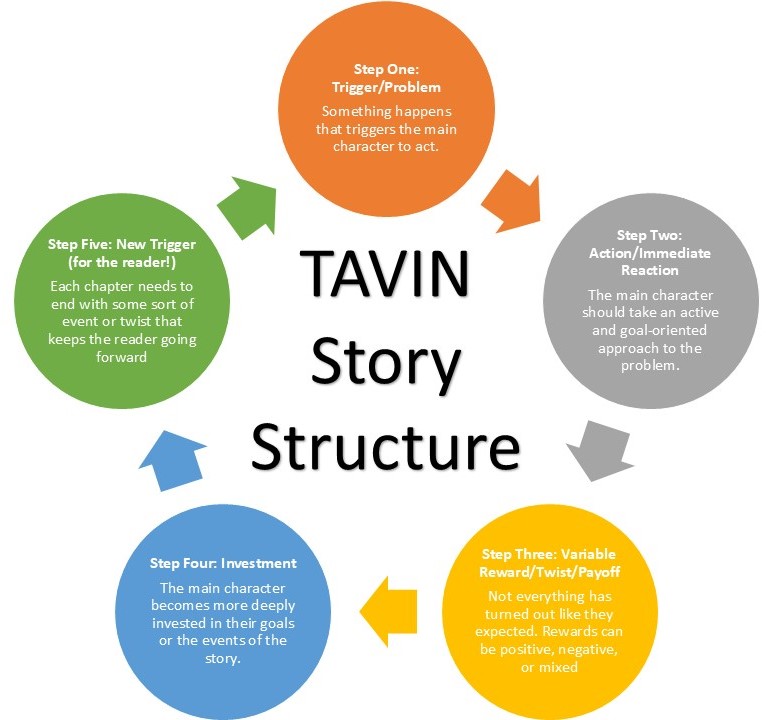
TAVIN story structure (action webfiction edition!)
To make it into a story structure, we’re using the basic four steps, plus one more, and adding more detail.
Step One: Trigger/Problem
Something happens that triggers the main character to act. This can be some personal need or it can be someone/something in the environment that makes them want to take action. Some common webfiction examples:
- Sudden Danger! – An attack or ambush; Catastrophic failure; Arrival of rival; Environmental threat (storm, quake, dungeon shift)
- Opportunity Appears! – New quest or contract; Power-up method discovered; Beneficial deal or negotiation; Open rank/title/territory to claim.
- Relationship Troubles! – Rival moves up rank; Love interest arrives; Friend behaves suspiciously; Mentor expresses disappointment
- Mystery Abounds! – Clue revealed; Foreshadowing of major event; Item/location behaves oddly; Revelation escalates stakes
Note: The trigger should always force the character to act, and it can’t be weak or optional. If the trigger itself is weak, then make sure the character is strongly motivated to deal with it anyway by raising the stakes or tension.
Step Two: Action/Immediate Reaction
The main character should react immediately to the issue – no procrastinating! If they’re sufficiently motivated, this should be a natural and logical reaction. They should take an active and goal-oriented approach to the problem that sends them clearly in the direction of chasing the reward.
Possible actions include: Fight back; Sneak in disguise; Make a bold move; Accept a deal reluctantly; Explore a new power; Repair/upgrade gear; Chase a target; Retrieve an object; Stake something in a gamble; Ask questions; Pressure ally/rival
If the action feels passive because the character is reacting instead of acting, then put the character in escalating danger and up the personal stakes. Or, if the character is doing something predictable, look for ways to add contrast, humor, irony, or have them experience a partial failure to make things more interesting.
Step Three: Variable Reward/Twist/Payoff
The main character may have succeeded (usually) or failed, but not everything has turned out like they expected. Rewards can be positive, negative, or mixed, and tend to come in three different flavors:
- Personal – Personal growth; Temptation; Doubt intensifies; Identity moment; Emotional realization
- Professional – Loot; Skill-up; Clue for future arc; Power with drawback; Item essential to progression
- Social – Relationship shift; Betrayal or unexpected loyalty; Praise or criticism; Rival’s surprising move; Ally failure
The important thing is to keep changing up the rewards and keep them unpredictable. Not all rewards are equal, and it’s important that sometimes Murphy’s Law kicks in so that the reader is always wondering how it’s going to turn out. After all, if the character is consistently getting the same results the story will get boring quickly.
Note: If the reward is obvious, consider adding a twist or partial failure to keep things interesting.
Step Four: Investment
Something happens which causes the main character to become more deeply invested in their goals or the events of the story. These can also be broken down into the same three categories:
- Personal – Makes vow or long-term plan; Increases stakes; Accepts emotional cost; Breaks personal rule
- Professional – Pays money/resources; Spends time/HP/energy; Sacrifices gear; Risks reputation or standing
- Social – Helps friend at cost; Gains follower or partner; Owes favor; Takes responsibility for group
The important part here is that the investment should lock the main character more deeply into their story arc and open up possibilities for future conflicts. These can be the results of the reward, or other story factors. They should also be things that make the reader more interested in what will happen to the character next and make them wonder how things will turn out.
Step Five: New Trigger (for the reader!)
A chapter/story arc should never end with things happily resolved because if you do that, the reader won’t have a trigger to read the next chapter! Each chapter needs to end with some sort of event or twist that keeps the reader going forward until it’s 4am and they have to get up for work in two hours.
Possible new triggers include:
- Cliffhanger – MC falls/fails; Threat appears; Time runs out; Ally missing; Mid-scene reveal
- Revelation – Villain identity twist; Key information uncovered; Clue redirects story; Emotional confession
- Countdown – Deadline introduced; Duel approaching; Search party closing in; Power fading or time-limited buff ending
The key is that this trigger must create curiosity in the reader by adding uncertainty or a threat to the character or their goals. Naturally, this must also loop into the main character’s personal trigger for the next chapter so they can once more jump right back into the action.
Things to consider
At their core, stories are about characters acting and getting results. The TAVIN story structure takes that and sharpens and expands it to make use of modern psychology so that action webfiction writers can write more addictive stories. It’s based on the Hooked Model conceived of by Nir Eyal, but expands and refines Nir’s core observations to apply them to serial webfiction. (And if you want to know more about the psychology behind it, I strongly suggest checking out Nir’s work!)
And, as with Nir’s work, the TAVIN structure isn’t something new, but a clearer way to look at something that has already existed for a long time. Modern serial webfiction is the result of storytelling evolution, and is built around a combination of Japanese serialized shonen manga storytelling techniques (Dragonball, One Piece, etc.) combined with the addictive storytelling of video games and TV dramas. These were refined by Korean and Chinese writers almost intuitively as the ones who wrote more popular/addictive stories prospered, and eventually made its way to the West through the litRPG/Progression Fantasy subgenres.
I mention this because if you want to see examples of this in action, look to shonen manga and progression fantasy like One Piece and Will Wight’s Cradle series to see how masters of the form use it. You will find that each chapter starts with a simple hook (trigger), throws a character into action, gives them some kind of reward/result that continues their story, and finally ends on some kind of cliffhanger to keep the reader wanting the next chapter.
And now you understand why!
Have fun!

Love it! Reminds me of the Hero’s Journey.
1. Call to Action
2. Crossing the Threshold
3. Belly of the Beast
4. The Dragon/ The Treasure
5. The Return